¶ Your brief
KEZA’s scholarship service sits behind an OAuth2 server. Irembo is a registered client: it exchanges a client id and secret for a short-lived access token. New idea: auth type CLIENT_CREDENTIALS, with the credentials in the query of the token call.
KEZA API guide · the slice you need
POST /oauth/token?grant_type=client_credentials&client_id=<id>&client_secret=<secret>
200  { "access_token", "token_type": "Bearer", "expires_in": 3600, "scope" }
401  { "error": "invalid_client" }

GET /v1/scholarships?nationalId=<id>
Authorization: Bearer <access_token>
200  { "nationalId", "scholarships": [ { "scholarshipCode", "programCode", "coverage", "status" } ] }
¶ Mock 1 · the OAuth token server
1 · Request: POST /victor/keza/oauth/token
2 · Responses (the first matching rule wins)
Rule 1 · Valid client
| Match on | Key | Operator | Value | |
|---|---|---|---|---|
| If | Query param | grant_type | equals | client_credentials |
| and | Query param | client_id | equals | irembo-hub |
| and | Query param | client_secret | equals | keza-secret-2026 |
Respond with 200 Body type json
{
  "access_token": "keza-oauth-9b21",
  "token_type": "Bearer",
  "expires_in": 3600,
  "scope": "scholarships.read"
}
Otherwise — when no rule above matches
Respond with 401 Body type json
{
  "error": "invalid_client",
  "error_description": "Client authentication failed."
}
3 · Label
| Field | Value |
|---|---|
| Name | Victor KEZA OAuth Token |
| Code | VICTOR_KEZA_OAUTH_TOKEN |
| Service | KEZA |
| Category | victor-course |
| Active | ✔ served by the mock server right away |
- Three Query param conditions: grant type, client id and secret must all match.
¶ Mock 2 · scholarships
1 · Request: GET /victor/keza/v1/scholarships
2 · Responses (the first matching rule wins)
Rule 1 · Aline has a scholarship
| Match on | Key | Operator | Value | |
|---|---|---|---|---|
| If | Header | Authorization | equals | Bearer keza-oauth-9b21 |
| and | Query param | nationalId | equals | 1199880012345678 |
Respond with 200 Body type json
{
  "nationalId": "1199880012345678",
  "scholarships": [
    {
      "scholarshipCode": "KZ-SCH-DA-2026",
      "programCode": "DATA_ANALYTICS",
      "coverage": "FULL",
      "status": "AWARDED"
    }
  ]
}
Rule 2 · No scholarship
| Match on | Key | Operator | Value | |
|---|---|---|---|---|
| If | Header | Authorization | equals | Bearer keza-oauth-9b21 |
Respond with 200 Body type jsonDynamic response ON
{
  "nationalId": "{{request.query.nationalId}}",
  "scholarships": []
}
Otherwise — when no rule above matches
Respond with 401 Body type json
{
  "error": "invalid_token",
  "error_description": "Access token missing or expired."
}
3 · Label
| Field | Value |
|---|---|
| Name | Victor KEZA Scholarships |
| Code | VICTOR_KEZA_SCHOLARSHIPS |
| Service | KEZA |
| Category | victor-course |
| Active | ✔ served by the mock server right away |
- Every rule requires
Bearer keza-oauth-9b21, the token issued by mock 1. - Rule 2 is dynamic: any other learner gets an empty list with their own ID echoed.
¶ How your teacher does it · Endpoints → New Endpoint
| Field | Value | |
|---|---|---|
| **Endpoint adapter *** | FMAPPING (fetch) |
locked after save |
| **Endpoint code *** | VICTOR_KEZA_SCHOLARSHIP_FETCH |
locked after save |
| **Endpoint url *** | http://mock-service-engine.apps:8000/victor/keza/v1/scholarships |
|
| **Endpoint type *** | FETCH (set by the adapter) |
|
| **Endpoint name *** | Victor KEZA Scholarships |
|
| **Partner *** | KEZA |
locked after save |
| Active | ON |
|
| **Endpoint description *** | Victor course: scholarship lookup behind OAuth2 client credentials. |
**Endpoint Mapping ***
{
  "method": "GET",
  "query": { "nationalId": nationalId },
  "auth": {
    "type": "CLIENT_CREDENTIALS",
    "baseUrl": "http://mock-service-engine.apps:8000",
    "parameters": {
      "authPath": "/victor/keza/oauth/token",
      "method": "POST",
      "query": {
        "grant_type": "client_credentials",
        "client_id": "irembo-hub",
        "client_secret": "keza-secret-2026"
      }
    },
    "tokenConfig": {
      "storageKey": "VICTOR_KEZA_OAUTH",
      "headerName": "Authorization",
      "tokenPrefix": "Bearer",
      "expiryBuffer": 300,
      "extractPath": "access_token"
    }
  }
}
- CLIENT_CREDENTIALS works exactly like USER_CREDENTIALS: call a token URL, extract, cache. Only the name differs.
- authPath is added to baseUrl:
http://mock-service-engine.apps:8000/victor/keza/oauth/token. - method: POST is the default; shown here for clarity.
- query on the token call: the engine does not add client_id/secret by itself. Put them where the partner wants them:
query,bodyTemplate(withcontentType) orheaders. The secret is a hard-coded training value (see the caveat below). - A different storage key from the login token: these are different credentials.
- extractPath access_token: OAuth servers return the token at the root. You could also write
"expiryBuffer": "expires_in"to use the server’s lifetime.
Secrets · training literal. Hard-coded only because KEZA is a training mock. In a real integration use the environment variable instead: keza-secret-2026 → "${KEZA_CLIENT_SECRET}" (the whole quoted string, nothing before or after; see Lesson 3.4).
Secrets · training value, not production practice
Clear-text value in this lesson: the client secret
keza-secret-2026. The value is hard-coded only because this is a training sandbox with a fake partner. In real integrations, keep secrets out of the mapping: use an environment variable that the platform team defines per environment.Proper configuration:
"query": {"grant_type": "client_credentials","client_id": "irembo-hub","client_secret": "${KEZA_CLIENT_SECRET}"}The format must be exact: the whole JSON string is
"${NAME}"(quotes included, nothing before or after)."Bearer ${NAME}","$NAME"and"{{NAME}}"are not resolved: they are sent as plain text. An unquoted$NAMEor$env.NAMEis an undefined JSONata variable, so the key is dropped from the request. A variable that is not defined on the environment stops every call with 500 MISSING_ENVIRONMENT_VARIABLE (Lesson 6.3 shows it in Kibana).
¶ Aline (scholarship awarded) · fetch/sync · VICTOR_KEZA_SCHOLARSHIP_FETCH
HTTP 200 1.02 s captured on staging · 26 Sep 2026
1 · Request (curl)
curl -s -X POST "https://integration-gateway.staging.iremboinc.com/integration/v1/fetch/sync" \
  -H "Authorization: Bearer $TOKEN" \
  -H "portal: integration-management-portal" \
  -H "Content-Type: application/json" \
  -d '{
  "endpointCode": "VICTOR_KEZA_SCHOLARSHIP_FETCH",
  "callerId": "victor-course",
  "requester": "victor-course",
  "payload": {
    "nationalId": "1199880012345678"
  }
}' | jq
2 · Real response
{
  "status": true,
  "responseCode": "integration_870000",
  "responseMessage": "integration_870000",
  "data": {
    "id": "c598cd9f-e6db-4be1-9ec9-98319de9e96d",
    "endpointCode": "VICTOR_KEZA_SCHOLARSHIP_FETCH",
    "callerId": "victor-course",
    "response": "{\n  \"nationalId\": \"1199880012345678\",\n  \"scholarships\": [\n    {\n      \"scholarshipCode\": \"KZ-SCH-DA-2026\",\n      \"programCode\": \"DATA_ANALYTICS\",\n      \"coverage\": \"FULL\",\n      \"status\": \"AWARDED\"\n    }\n  ]\n}",
    "adapterCode": "FMAPPING"
  },
  "timestamp": "2026-09-26T09:48:14.506183964",
  "traceId": "6ab778be2627e4454a05ce85ca67a0a8"
}
3 · Decoded data.response
{
  "nationalId": "1199880012345678",
  "scholarships": [
    {
      "scholarshipCode": "KZ-SCH-DA-2026",
      "programCode": "DATA_ANALYTICS",
      "coverage": "FULL",
      "status": "AWARDED"
    }
  ]
}
4 · What to notice
- Two HTTP calls happened: token, then scholarships. Only the scholarships call appears in the Communication Trace; the token call is logged in Kibana (Lesson 6.3).
¶ Eric (none) · fetch/sync · VICTOR_KEZA_SCHOLARSHIP_FETCH
HTTP 200 1.21 s captured on staging · 26 Sep 2026
1 · Request (curl)
curl -s -X POST "https://integration-gateway.staging.iremboinc.com/integration/v1/fetch/sync" \
  -H "Authorization: Bearer $TOKEN" \
  -H "portal: integration-management-portal" \
  -H "Content-Type: application/json" \
  -d '{
  "endpointCode": "VICTOR_KEZA_SCHOLARSHIP_FETCH",
  "callerId": "victor-course",
  "requester": "victor-course",
  "payload": {
    "nationalId": "1199770098765432"
  }
}' | jq
2 · Real response
{
  "status": true,
  "responseCode": "integration_870000",
  "responseMessage": "integration_870000",
  "data": {
    "id": "70bb9f85-4a27-47ee-8a7c-fe9e07abc884",
    "endpointCode": "VICTOR_KEZA_SCHOLARSHIP_FETCH",
    "callerId": "victor-course",
    "response": "{\n  \"nationalId\": \"1199770098765432\",\n  \"scholarships\": []\n}",
    "adapterCode": "FMAPPING"
  },
  "timestamp": "2026-09-26T09:48:15.948448651",
  "traceId": "6ab778bf8a3b2f4de7698e29f0a2707a"
}
3 · Decoded data.response
{
  "nationalId": "1199770098765432",
  "scholarships": []
}
4 · What to notice
- The token is cached under
VICTOR_KEZA_OAUTHand reused while it is younger than expiryBuffer. Kibana shows whether a token call happened: look forSending HTTP request to …/oauth/token(Lesson 6.3). - Empty list, HTTP 200: “no scholarship” is not an error.
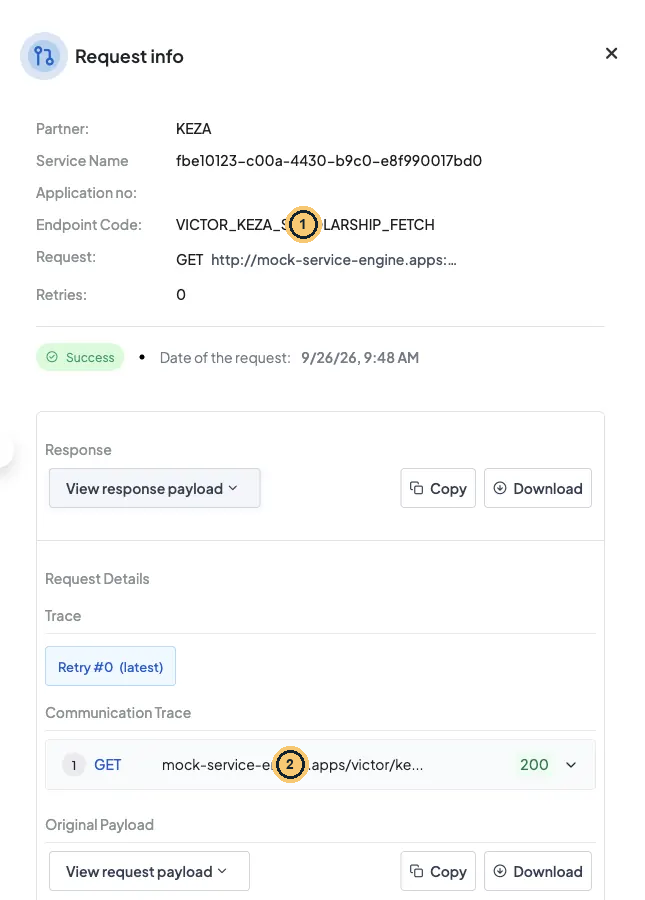
Real capture (staging): Request info of VICTOR_KEZA_SCHOLARSHIP_FETCH, an OAuth2 endpoint
- The endpoint code: CLIENT_CREDENTIALS auth, so the engine needed a token first.
- Only one call is listed: the scholarship GET. The token call is not in the Communication Trace; find it in Kibana (Lesson 6.3).
Your tech notes · Form-encoded token servers
Many OAuth servers want the credentials as a form body. Use
"contentType": "application/x-www-form-urlencoded"and putgrant_type,client_idandclient_secretinbodyTemplate.
¶ Check yourself
The token server answers {"data":{"accessToken":"abc","ttl":900}}. What do you set?
- A. extractPath "data.accessToken", expiryBuffer "data.ttl"
- B. extractPath "data.accessToken", expiryBuffer "ttl"
- C. extractPath "data.access_token", expiryBuffer "data.expires_in"
- D. extractPath "$.data.accessToken", no expiryBuffer
Show the answer
A. Both are JSONata paths into the token response. Without a valid expiryBuffer the call fails with TOKEN_EXPIRY_EXTRACTION_ERROR.
Your turn · see the token cache work
Copy both mocks to
/${your_first_name}/keza/…and create${YOUR_FIRST_NAME}_KEZA_SCHOLARSHIP_FETCH(FMAPPING) with storageKey${YOUR_FIRST_NAME}_KEZA_OAUTH. Replace the variables before saving (Aline →ALINE_…,/aline/…).
- Call it for Aline twice. Check: both Communication Traces list one call (scholarships). In Kibana, only the first call has a
Sending HTTP request to …/oauth/tokenline (Lesson 6.3).- Predict, then test: change
client_secretto a wrong value and call again. It still answers 200: the cached token is reused.- Change the storageKey to
${YOUR_FIRST_NAME}_KEZA_OAUTH_2. Now the fresh login fails with the token server’sinvalid_client401. Restore the secret.
← 3.2 Basic auth (BASIC): certificate check · 3.4 Choose and troubleshoot authentication →