¶ Your toolkit
Everything in the portal can be proven with two tools: a Keycloak token and curl. Run this once per session (the token expires after a few minutes; just re-run it when you get a 401).
Terminal · get a token
# 1. Your staging portal login (never paste real passwords into shared files)
export USER_EMAIL="you@example.com"
export USER_PASSWORD="your-password"

# 2. Get a Keycloak access token (it expires after a few minutes; re-run if you get 401)
TOKEN=$(curl -s -X POST \
  "https://keycloak.staging.iremboinc.com/realms/irembo-staging/protocol/openid-connect/token" \
  -d grant_type=password -d client_id=integration-management-portal \
  -d username="$USER_EMAIL" -d password="$USER_PASSWORD" | jq -r .access_token)

echo ${TOKEN:0:20}...   # prints the start of the token if it worked
¶ Step 1 · Test the mapping without calling KEZA
The mapping test runs only the request pass of your mapping against a sample payload and shows what the engine would send. It calls nobody, so it is safe and fast. It has no portal button: call it with curl.
¶ Mapping test (request pass only) · mapping/test · VICTOR_KEZA_ELIGIBILITY_FETCH
HTTP 200 captured on staging · 26 Sep 2026
1 · Request (curl)
curl -s -X POST "https://integration-gateway.staging.iremboinc.com/integration/v1/endpoints/VICTOR_KEZA_ELIGIBILITY_FETCH/mapping/test" \
  -H "Authorization: Bearer $TOKEN" \
  -H "portal: integration-management-portal" \
  -H "Content-Type: application/json" \
  -d '{
  "nationalId": "1199880012345678",
  "programCode": "DATA_ANALYTICS"
}' | jq '.data'
2 · What the engine would send
{
  "method": "GET",
  "query": {
    "nationalId": "1199880012345678",
    "program": "DATA_ANALYTICS"
  },
  "auth": {
    "type": "USER_CREDENTIALS",
    "baseUrl": "http://mock-service-engine.apps:8000",
    "parameters": {
      "authPath": "/victor/keza/v1/auth/login",
      "bodyTemplate": {
        "username": "irembo-integration",
        "password": "Keza@2026"
      }
    },
    "tokenConfig": {
      "storageKey": "VICTOR_KEZA_TOKEN",
      "headerName": "Authorization",
      "tokenPrefix": "Bearer",
      "expiryBuffer": 300,
      "extractPath": "data.token"
    }
  }
}
3 · What to notice
programnow holds the value ofprogramCode: the rename worked.- The auth block is echoed with the password in clear text. Never paste mapping-test output into tickets or chats.
- No token, no partner call: the test cannot prove the login works. Only a real call can.
¶ Step 2 · Call it for real: Aline
Now call /fetch/sync. The engine logs in, calls the eligibility mock and wraps the answer in the success envelope.
¶ Prove it · fetch/sync · VICTOR_KEZA_ELIGIBILITY_FETCH
HTTP 200 0.87 s captured on staging · 26 Sep 2026
1 · Request (curl)
curl -s -X POST "https://integration-gateway.staging.iremboinc.com/integration/v1/fetch/sync" \
  -H "Authorization: Bearer $TOKEN" \
  -H "portal: integration-management-portal" \
  -H "Content-Type: application/json" \
  -d '{
  "endpointCode": "VICTOR_KEZA_ELIGIBILITY_FETCH",
  "callerId": "victor-course",
  "requester": "victor-course",
  "payload": {
    "nationalId": "1199880012345678",
    "programCode": "DATA_ANALYTICS"
  }
}' | jq
2 · Real response
{
  "status": true,
  "responseCode": "integration_870000",
  "responseMessage": "integration_870000",
  "data": {
    "id": "2e438be6-0c78-478f-871f-abd9e735d2d7",
    "endpointCode": "VICTOR_KEZA_ELIGIBILITY_FETCH",
    "callerId": "victor-course",
    "response": "{\n  \"found\": true,\n  \"learner\": {\n    \"nationalId\": \"1199880012345678\",\n    \"firstName\": \"Aline\",\n    \"lastName\": \"Mukamana\",\n    \"district\": \"Gasabo\"\n  },\n  \"eligibility\": {\n    \"status\": \"ELIGIBLE\",\n    \"programCode\": \"DATA_ANALYTICS\",\n    \"reasonCode\": null,\n    \"evaluatedAt\": \"2026-09-26T08:00:00Z\"\n  }\n}",
    "adapterCode": "FMAPPING"
  },
  "timestamp": "2026-09-26T09:59:40.977889843",
  "traceId": "6ab77b6c9f1234521f86de28934960bd"
}
3 · Decoded data.response
{
  "found": true,
  "learner": {
    "nationalId": "1199880012345678",
    "firstName": "Aline",
    "lastName": "Mukamana",
    "district": "Gasabo"
  },
  "eligibility": {
    "status": "ELIGIBLE",
    "programCode": "DATA_ANALYTICS",
    "reasonCode": null,
    "evaluatedAt": "2026-09-26T08:00:00Z"
  }
}
4 · What to notice
- HTTP 200 and
integration_870000: the engine, the login and the mock all worked. data.responseis a string; tab 3 shows it parsed withjq '.data.response | fromjson'.adapterCode FMAPPINGconfirms a fetch endpoint answered.- Keep the
traceIdand thedata.id(the Request id) when you report problems: both find the call’s log lines in Kibana (Lesson 6.3).
¶ Step 3 · The three other cases
Always prove the unhappy paths too. Read each result before you open the explanation.
¶ Eric (not eligible) · fetch/sync · VICTOR_KEZA_ELIGIBILITY_FETCH
HTTP 200 0.71 s captured on staging · 26 Sep 2026
1 · Request (curl)
curl -s -X POST "https://integration-gateway.staging.iremboinc.com/integration/v1/fetch/sync" \
  -H "Authorization: Bearer $TOKEN" \
  -H "portal: integration-management-portal" \
  -H "Content-Type: application/json" \
  -d '{
  "endpointCode": "VICTOR_KEZA_ELIGIBILITY_FETCH",
  "callerId": "victor-course",
  "requester": "victor-course",
  "payload": {
    "nationalId": "1199770098765432",
    "programCode": "DATA_ANALYTICS"
  }
}' | jq
2 · Real response
{
  "status": true,
  "responseCode": "integration_870000",
  "responseMessage": "integration_870000",
  "data": {
    "id": "b31c07f5-3572-4e78-9f74-895286a5905c",
    "endpointCode": "VICTOR_KEZA_ELIGIBILITY_FETCH",
    "callerId": "victor-course",
    "response": "{\n  \"found\": true,\n  \"learner\": {\n    \"nationalId\": \"1199770098765432\",\n    \"firstName\": \"Eric\",\n    \"lastName\": \"Habimana\",\n    \"district\": \"Huye\"\n  },\n  \"eligibility\": {\n    \"status\": \"NOT_ELIGIBLE\",\n    \"programCode\": \"DATA_ANALYTICS\",\n    \"reasonCode\": \"AGE_LIMIT\",\n    \"evaluatedAt\": \"2026-09-26T08:00:00Z\"\n  }\n}",
    "adapterCode": "FMAPPING"
  },
  "timestamp": "2026-09-26T09:59:41.728642914",
  "traceId": "6ab77b6d2466da5a590f4315e382c5dc"
}
3 · Decoded data.response
{
  "found": true,
  "learner": {
    "nationalId": "1199770098765432",
    "firstName": "Eric",
    "lastName": "Habimana",
    "district": "Huye"
  },
  "eligibility": {
    "status": "NOT_ELIGIBLE",
    "programCode": "DATA_ANALYTICS",
    "reasonCode": "AGE_LIMIT",
    "evaluatedAt": "2026-09-26T08:00:00Z"
  }
}
4 · What to notice
- Eric is NOT_ELIGIBLE, yet the engine says success (200). The engine only judges HTTP; business meaning is your job.
- In Module 4 you will turn this into a clean 400 KEZA_NOT_ELIGIBLE with a response validation.
¶ Unknown learner · fetch/sync · VICTOR_KEZA_ELIGIBILITY_FETCH
HTTP 500 1.60 s captured on staging · 26 Sep 2026
1 · Request (curl)
curl -s -X POST "https://integration-gateway.staging.iremboinc.com/integration/v1/fetch/sync" \
  -H "Authorization: Bearer $TOKEN" \
  -H "portal: integration-management-portal" \
  -H "Content-Type: application/json" \
  -d '{
  "endpointCode": "VICTOR_KEZA_ELIGIBILITY_FETCH",
  "callerId": "victor-course",
  "requester": "victor-course",
  "payload": {
    "nationalId": "1190000000000009",
    "programCode": "DATA_ANALYTICS"
  }
}' | jq
2 · Real response
{
  "httpStatus": 500,
  "exception": "PartnerException",
  "responseCode": "PARTNER_ERROR_FETCH-VICTOR_KEZA_ELIGIBILITY_FETCH",
  "responseMessage": "{\n  \"found\": false,\n  \"code\": \"LEARNER_NOT_FOUND\",\n  \"message\": \"No learner matches the supplied National ID.\"\n}",
  "fieldErrors": null
}
3 · What to notice
- KEZA answered 404, and the engine reports HTTP 500 with
PARTNER_ERROR_FETCH-<endpoint code>. - The partner’s body is passed through in
responseMessage: that is how you know what KEZA said. - Partner 4xx/5xx come back as 500
PARTNER_ERROR_*unless a successCondition accepts them (Lesson 4.3). Do not waste time looking for a bug in the engine.
¶ Typo in the endpoint code · fetch/sync · VICTOR_KEZA_ELIGIBILTY_FETCH
HTTP 404 0.57 s captured on staging · 26 Sep 2026
1 · Request (curl)
curl -s -X POST "https://integration-gateway.staging.iremboinc.com/integration/v1/fetch/sync" \
  -H "Authorization: Bearer $TOKEN" \
  -H "portal: integration-management-portal" \
  -H "Content-Type: application/json" \
  -d '{
  "endpointCode": "VICTOR_KEZA_ELIGIBILTY_FETCH",
  "callerId": "victor-course",
  "requester": "victor-course",
  "payload": {
    "nationalId": "1199880012345678",
    "programCode": "DATA_ANALYTICS"
  }
}' | jq
2 · Real response
{
  "httpStatus": 404,
  "exception": "NotFoundException",
  "responseCode": "ENDPOINT_NOT_FOUND_EXCEPTION",
  "responseMessage": "ENDPOINT_NOT_FOUND_EXCEPTION",
  "fieldErrors": []
}
3 · What to notice
- A one-letter typo in
endpointCode(ELIGIBLTY) gives 404 ENDPOINT_NOT_FOUND_EXCEPTION. - No Request is created: nothing reached an endpoint. Check spelling and case first.
Reading a fetch result
| You see | It means | Look at |
|---|---|---|
200 integration_870000 |
Partner answered 2xx | Decode data.response and check the business fields |
500 PARTNER_ERROR_FETCH-<code> |
Partner answered 4xx/5xx or timed out | responseMessage (the partner body), then the trace in Requests |
404 ENDPOINT_NOT_FOUND_EXCEPTION |
No endpoint with that code | Spelling and case of endpointCode |
400 BAD_REQUEST |
Envelope field missing (callerId, requester, payload…) | Your curl body |
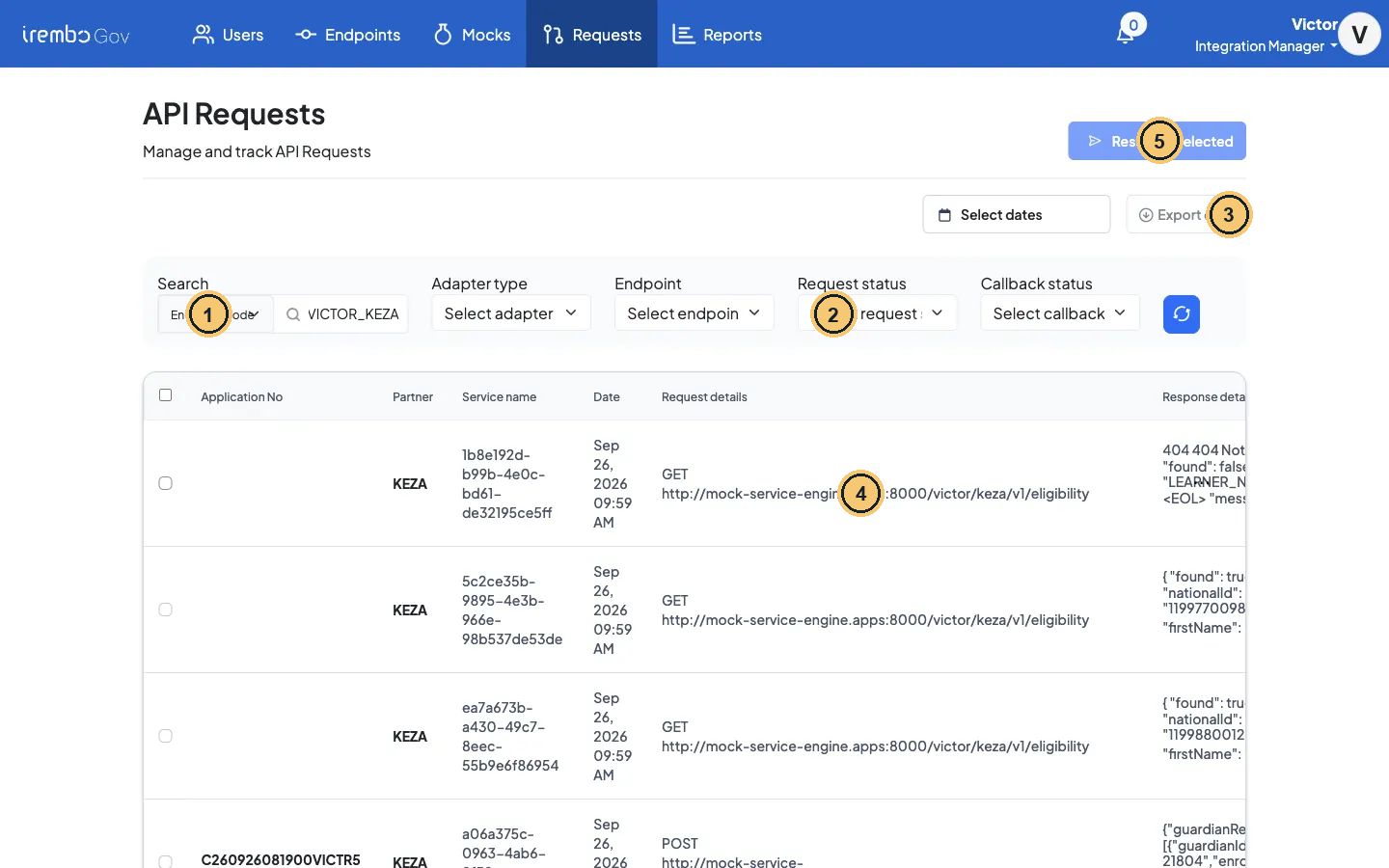
API Requests, searched by endpoint code VICTOR_KEZA
- Search selector set to Endpoint Code, then your prefix.
- Adapter type, Endpoint, Request status and Callback status filters.
- Export data: CSV of the current filters.
- Request details: the verb and the URL the engine really called.
- Resubmit selected: async pushes only (Module 6).
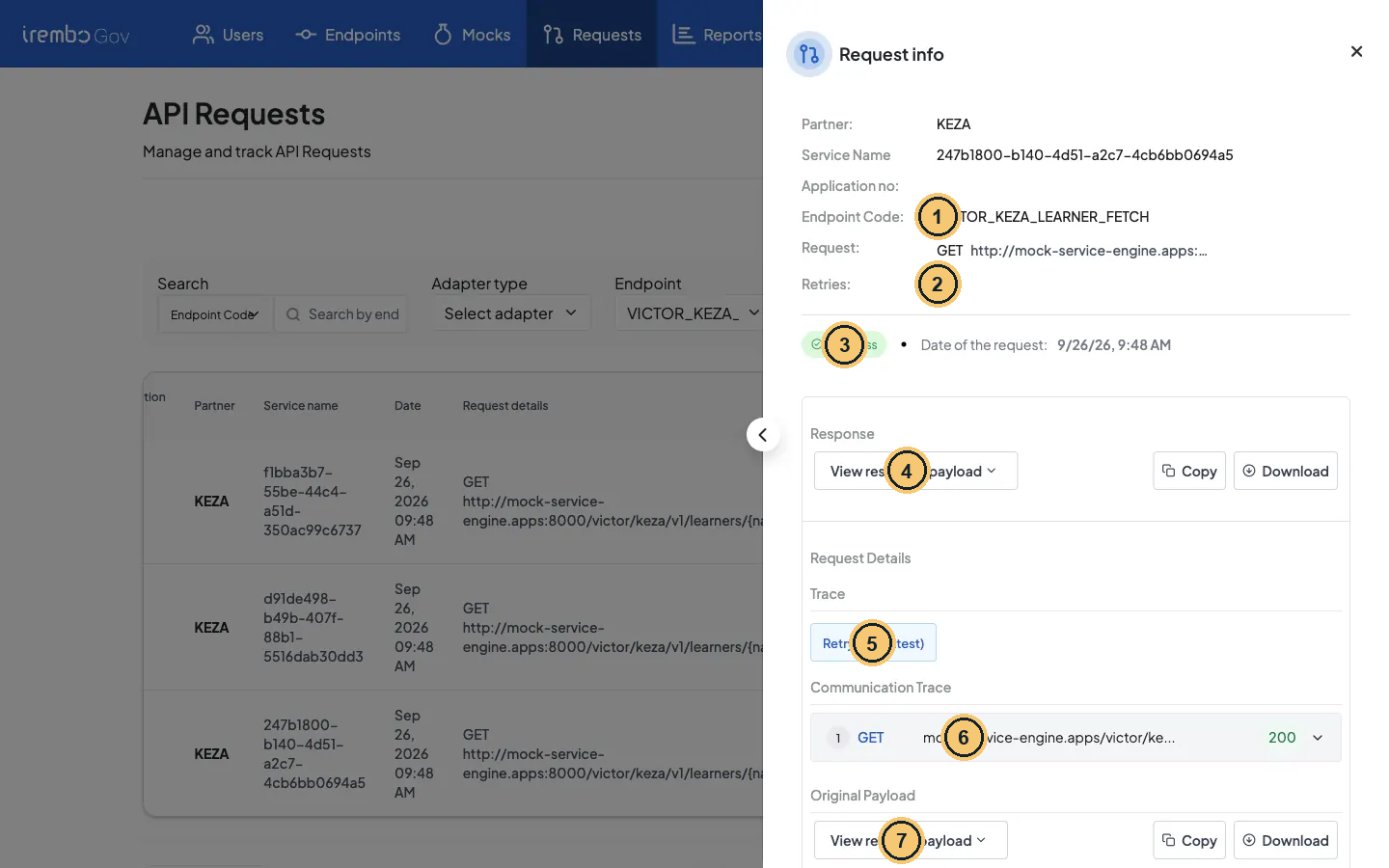
Request info for a successful fetch
- Endpoint code and the configured URL.
- Retries: how many times it was resubmitted.
- Status and date. Change request status appears here when not SUCCESS.
- Response: view, copy or download the payload (or the error).
- Trace: one tab per attempt, newest marked (latest).
- Communication Trace: the partner call(s) of this attempt, with their HTTP status (login and token calls are only in Kibana).
- Original Payload: exactly what the caller sent.
Gotcha · Same application number, same old payload
When a fetch payload carries an
applicationNumber, the engine treats repeat calls for the same partner, endpoint and application as the same request and reuses the first payload it stored, even if you changed a field. When testing, use a fresh application number (or none) for each variation.
¶ Check yourself
You call VICTOR_KEZA_ELIGIBILITY_FETCH and get HTTP 500 PARTNER_ERROR_FETCH-VICTOR_KEZA_ELIGIBILITY_FETCH with responseMessage {"code":"UNAUTHORIZED"}. What is the most likely cause?
- A. KEZA got the call without a valid bearer token
- B. The endpoint code in the curl is misspelled
- C. Your curl’s Keycloak token has expired
- D. KEZA does not know this learner’s National ID
Show the answer
A. The partner body says UNAUTHORIZED, so the engine reached the partner but the partner rejected the token. An expired Keycloak token would be rejected by the gateway before the engine (plain 401, no PARTNER_ERROR).
Your turn · prove your own endpoint
Run the mapping test and the four fetch calls against your
${YOUR_FIRST_NAME}_KEZA_ELIGIBILITY_FETCH. Then open Requests, search your endpoint code and open the trace of the unknown-learner call. Screenshot it: it is the first item of your capstone evidence pack.
← 1.5 Your first endpoint, with login authentication · 2.1 Path parameters: prefill the learner profile →